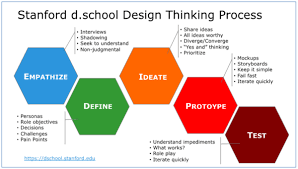
- Empathy: Put yourself in the shoes of those you are designed for to understand their physical and emotional needs.
- Define: In define mode, bringing more clarity to the design process by crafting a meaningful problem statement.
- Ideate: This is the phase where designer generating ideas through brainstorming, mind mapping or sketching techniques.
- Prototype: It is an iterative generation of artefacts, strategies or intervention to answer questions which lead you closer to your final solution.
- Test: In this ultimate step, solving the identified issue by different strategies also it provides solicit feedback and learn more about the user.
In the educational field, teachers, parents and students are confronting with various challenges which revolve around the design thinking process and making modifications in the identified issue which might be done through improvising: curriculum, learning spaces, teaching methods in the classrooms, goals and policies (IDEO, 2017). The following post will discuss the challenges and innovation for physical learning space at my context by developing a deeper reflection on the first two phases of the design thinking process: empathy and synthesis. I believe that empathising and synthesising are the critical stages of design thinking process. As a postgraduate student from special education, I would like to use this opportunity of design thinking, for my students who want special learning environment and support in the mainstream setting.

 BLOOMING TECHNOLOGY