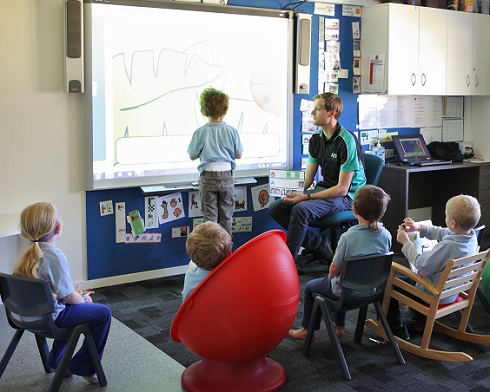
Nowadays many schools are adopting an interactive whiteboard (IWB) as a great helping tool for people with autism to modify their visual support, imagination and social interactions. The main attraction of this IWB is the capacity to support pedagogy depends on the visual modality of students on the spectrum (Aspect, 2019). Studies identified that students having autism paying more attention during activities in the smart board and they used the tools to express ideas and also modelling positive classroom behaviours for their peers (Advanced Education, 2019). The interactive online tools, desktop drawing software helped to transform the learning environment and gave autistic learners a voice in the classroom. Hence interactive whiteboards are commonly using in the classroom for students with autism to improve their communication, attention, computer literacy moreover creative engagement. Despite IWB act as an effective teaching tool, for a farsighted student, it will be a serious obstacle for meaningful learning (McGrath, 2011). Even though touching a screen and seeing an immediate reaction gives a positive reaction to many students but the farsighted student face difficulty in reading when standing close to the screen.
An example of promoting creativity

Recently Aspect (2019) introduced a social skill program called The Secret Agent Society (SAS) for 8 to 12-year old children. This programme provides a set of resources to promote children emotional and social skills with the support of technology-based educational activities. It comprises of complex computer games, walkie-talkie game and simple board games to identify simple and complex emotions and environmental clues. Similarly, a new music project launched to explore the musical passion of people with autism. For that purpose using Ableton Live Suite 9 software and Push instrument which makes different patterns, create sounds, sequences and melodies and it is particularly suited for people with ASD (Aspect, 2019). It is a remarkable example of technological use for promoting creativity among people with autism.

 BLOOMING TECHNOLOGY