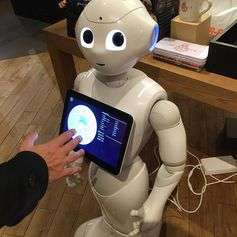
There are many robots are developed for helping people with autism especially for their individualized therapy and communication skill development. Robots are considering as great instructors for autistic children since they can repeat instructions and answers numerous times without any tiredness. Nowadays various type of robots is incorporated into the education stream ranging from simple to humanoids. In some schools in Australia, implemented a humanoid NAO robot which is particularly designed for children with ASD. This social robot NAO can talk by itself and even seems to recognize some emotions with the help of built-in cameras, detectors and microphones (Karsenti, Bugmann, & Gros 2017). The interactions with robots help students with ASD to develop social skills. NAO could help to develop a better sense of touch in people with autism and self-awareness of their body further it can support autism therapies related to the cognitive development of children with ASD. Studies prove that there are several positive outcomes of the educational use of robots with ASD students such as increased motivation and longer attention span, improved language skill, improved socialization, improved writing and reading skill and improved body control. Despite all these positive outcomes the initial contacts between the students and robots may not successful always. Research shows that many teachers are slightly reluctant to use the robots in the classroom and wanted full control over the robot (Physorg, 2019).
While discussing the contributions and advantages of Artificial Intelligence, it should be useful to critically discuss the disadvantages too. Even though there is enormous support for students creative learning, tracking a student’s well-being would be harder for a robot or AI to interpret. Understanding the emotional changes of a person precisely would not be successful for robots hence the well-being and emotional intelligence will remain in the realm of teachers. Human experience in making educational decisions about learning pathways for students especially using background knowledge can be done effectively only by the presence of an expert teacher. The very act of being present with one’s body and using the body gesture for energise the classroom and understanding the heart of students will remain safe with teachers than any robot and AI. The relationships with children and their families and an understanding of the context in which operate can never be replaced by AI.

 BLOOMING TECHNOLOGY